

ADHD in Children Signs Parents Should Not Ignore
Every child can be energetic, distracted, forgetful, or impulsive at times. However, when these behaviors happen often, affect school performance, create problems at home, or make it hard for a child to build healthy routines, parents may begin to wonder if ADHD could be involved.
ADHD, or Attention Deficit Hyperactivity Disorder, is a common childhood condition that can affect attention, behavior, self-control, learning, and daily activities. Some children mainly struggle with focus, while others may seem overly active, impulsive, or emotionally reactive.
At Richmond Medical Clinic, our pediatric care team supports families in Richmond, TX with child health concerns, developmental questions, routine checkups, and guidance when parents notice changes in their child’s behavior, focus, or school performance.
What Is ADHD in Children?
ADHD is a neurodevelopmental condition that usually begins in childhood. It can make it harder for a child to pay attention, control impulses, stay organized, sit still, or complete tasks. ADHD is not a sign of laziness, poor parenting, or lack of intelligence. Many children with ADHD are bright, creative, and capable, but they may need the right support to manage daily challenges.
ADHD symptoms can look different from child to child. One child may constantly move, interrupt, and act before thinking. Another child may be quiet but forgetful, distracted, and unable to finish schoolwork. Because symptoms can vary, parents should look for patterns that continue over time and affect daily life.
Common Signs of ADHD Parents Should Watch For
Children naturally have different energy levels and attention spans. The concern starts when symptoms are frequent, ongoing, and interfere with home, school, friendships, or daily routines.
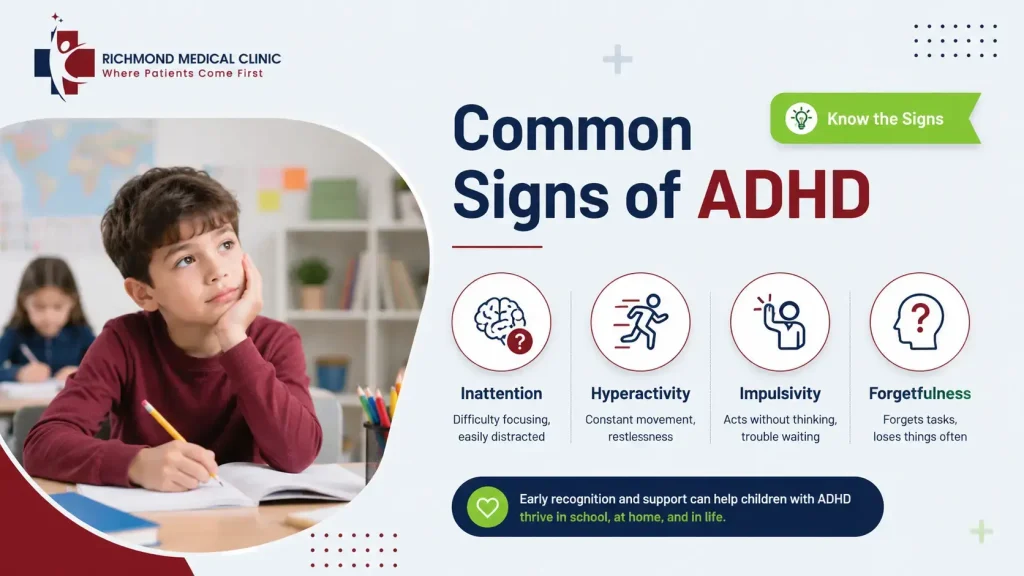
ADHD Sign |
What Parents May Notice |
|
Trouble Paying Attention |
Child gets distracted easily, misses details, or struggles to finish tasks |
|
Forgetfulness |
Child often loses school items, forgets instructions, or needs repeated reminders |
|
Poor Organization |
Backpack, homework, room, or schoolwork may feel constantly messy or unfinished |
|
Fidgeting or Restlessness |
Child squirms, taps, moves around, or struggles to sit still |
|
Excessive Talking |
Child talks often, interrupts, or has trouble waiting for others to finish |
|
Impulsive Behavior |
Child acts quickly without thinking about safety, rules, or consequences |
|
Trouble Waiting Turns |
Child becomes frustrated while waiting in lines, games, or group activities |
|
Emotional Outbursts |
Child may react strongly to small problems or become upset quickly |
If these signs happen once in a while, they may be part of normal childhood behavior. If they happen often and cause ongoing difficulty, it may be time to speak with a medical provider.
Inattention Signs in Children
Some children with ADHD struggle mostly with attention. These children may not seem disruptive, so their symptoms can be easier to miss. Parents may notice that their child daydreams often, forgets homework, loses items, or has trouble following multi-step directions.
Inattention can show up as unfinished schoolwork, careless mistakes, difficulty listening, or taking much longer than expected to complete simple tasks. A child may understand the work but still struggle to stay focused long enough to finish it.
This type of ADHD can be especially confusing for parents because the child may focus well on games, videos, or favorite activities but struggle with schoolwork, chores, or routines. This does not always mean the child is choosing not to listen. It may mean the task requires a level of attention and organization that is difficult for them to manage.
Hyperactivity Signs in Children
Hyperactivity means a child has a high level of movement or restlessness that does not fit the situation. Parents may notice that their child runs or climbs when it is not appropriate, leaves their seat often, fidgets constantly, or seems unable to relax.
A hyperactive child may also talk a lot, make noises, interrupt activities, or move from one thing to another quickly. In younger children, this may look like constant motion. In older children or teens, it may look more like inner restlessness, impatience, or difficulty staying focused during quiet activities.
Impulsivity Signs in Children
Impulsivity means acting before thinking. A child may interrupt conversations, grab things, shout out answers, take risks, or have trouble waiting. They may also make quick decisions without understanding the results.
Impulsive behavior can affect friendships, classroom behavior, and safety. A child may not mean to be rude or difficult, but their brain may have trouble pausing before reacting. When this becomes a repeated pattern, parents should pay attention.
ADHD vs Normal Childhood Behavior
It is important to remember that many ADHD-like behaviors can happen in children who do not have ADHD. Lack of sleep, stress, anxiety, vision or hearing problems, learning difficulties, family changes, or too much screen time can also affect attention and behavior.
The difference is usually based on how often the behavior happens, how long it has been happening, and whether it affects daily life.
Normal Childhood Behavior |
Possible ADHD Concern |
|
Gets distracted sometimes |
Struggles to focus most days, even with reminders |
|
Has high energy during play |
Cannot sit still in school, meals, or quiet settings |
|
Forgets tasks occasionally |
Frequently loses items, forgets homework, or misses instructions |
|
Interrupts once in a while |
Regularly interrupts, blurts out, or cannot wait turns |
|
Has occasional emotional reactions |
Has frequent outbursts that affect home, school, or friendships |
|
Avoids boring tasks sometimes |
Regularly cannot finish tasks that require focus or organization |
If your child’s behavior is causing problems in more than one setting, such as both home and school, it is a good idea to talk with a pediatric provider.
When Should Parents Seek Medical Guidance?
Parents should consider scheduling a visit if their child’s attention, activity level, or impulsive behavior is affecting school performance, family routines, social relationships, or emotional well-being.
You may want to seek help if your child often struggles to complete homework, receives repeated school complaints, has frequent emotional outbursts, loses important items, cannot follow instructions, or seems unable to control impulsive actions.
Parents should also seek support if teachers report ongoing concerns or if the child feels frustrated, embarrassed, anxious, or “always in trouble.” Early guidance can help families understand what may be happening and what support may help.
How ADHD Can Affect School and Home Life
ADHD can affect many areas of a child’s life. At school, a child may struggle with homework, tests, organization, listening, sitting still, or following classroom rules. At home, parents may notice difficulty with bedtime routines, chores, morning schedules, or emotional control.
ADHD can also affect friendships. A child may interrupt, act too quickly, become frustrated during games, or have trouble understanding social cues. Over time, these challenges can affect confidence and self-esteem.
The goal of care is not to change the child’s personality. The goal is to understand their needs and create better support at home, school, and in daily routines.
What Happens During an ADHD Evaluation?
An ADHD evaluation usually begins with a careful discussion about your child’s behavior, health history, school performance, sleep, daily routines, and family concerns. Your provider may ask when the symptoms started, where they happen, and how they affect daily life.
The provider may also ask for input from parents and teachers because ADHD symptoms often need to be reviewed in more than one setting. In some cases, additional screening may be recommended to check for learning concerns, anxiety, sleep issues, vision or hearing problems, or other conditions that may look similar to ADHD.
A proper evaluation is important because ADHD should not be diagnosed from one symptom or one bad week. It requires a full look at patterns, history, and how the symptoms affect the child’s life.
How Parents Can Support a Child With ADHD-Like Symptoms
Even before a final diagnosis, parents can start using supportive routines at home. Simple structure can make a big difference for children who struggle with attention or impulsivity.
Try keeping morning and bedtime routines consistent. Break large tasks into smaller steps. Use clear instructions instead of long explanations. Keep school supplies and daily items in the same place. Praise effort and progress instead of focusing only on mistakes.
Children with ADHD-like symptoms often do better when expectations are clear, routines are predictable, and adults respond calmly. Support from parents, teachers, and healthcare providers can help children build confidence and better habits over time.
Pediatric ADHD Support in Richmond, TX
Even before a final diagnosis, parents can start using supportive routines at home. Simple structure can make a big difference for children who struggle with attention or impulsivity.
Richmond Medical Clinic provides pediatric care services in Richmond, TX, including child health evaluations, developmental support, wellness visits, and guidance for families dealing with attention and behavior concerns.
Our team can help parents take the next step with clear, compassionate care focused on your child’s physical, emotional, and developmental health.
When to Seek Urgent Help
ADHD symptoms are usually not an emergency. However, parents should seek urgent medical or mental health support if a child talks about self-harm, becomes physically unsafe, has severe emotional distress, or shows sudden major changes in behavior.
If symptoms feel life-threatening or your child may harm themselves or someone else, call 911 or go to the nearest emergency room.
Schedule a Pediatric Visit in Richmond, TX
If your child is struggling with focus, impulsive behavior, school challenges, or emotional outbursts, scheduling a pediatric visit can help you get answers. Early support can make daily life easier for your child and your family.